

Floorstanding vs. Bookshelf Speakers: Which Is Right for Your Room?
You have decided to invest in proper speakers. But one question keeps coming up: should you go with floorstanding speakers or bookshelf speakers?
It is a genuine dilemma - and the answer depends more on your room and listening habits than on price. Both types can sound exceptional. Both have clear advantages. And choosing the wrong one for your space can leave even a great speaker performing below its potential.
This guide breaks down exactly how the two types differ, what each does best, and which is the right choice for your specific situation.
What Are Floorstanding Speakers?
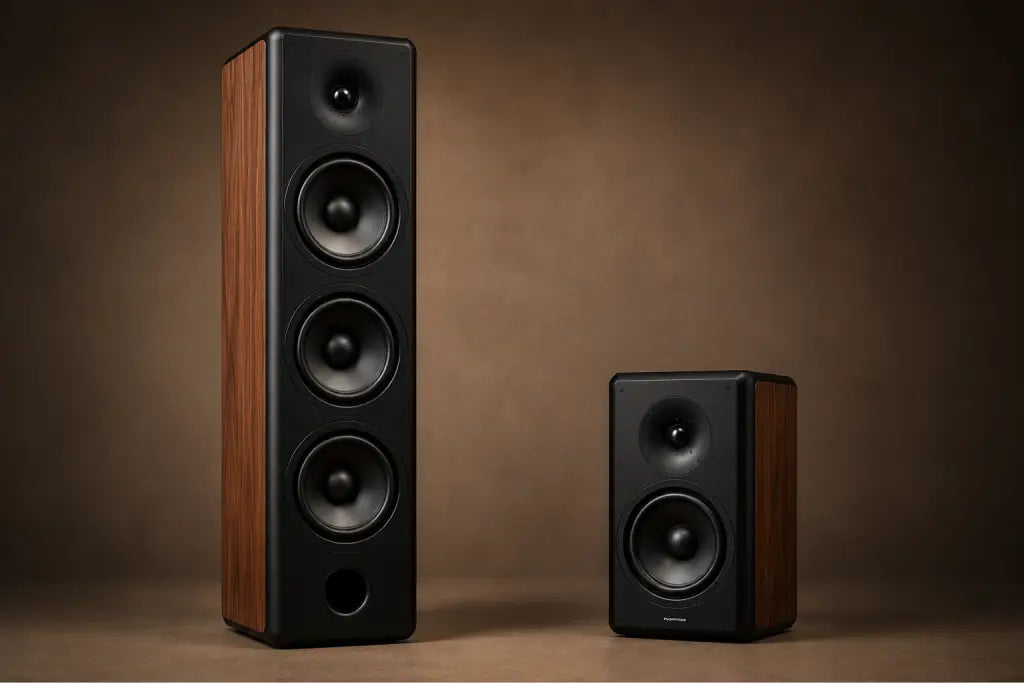
Floorstanding speakers - also called tower speakers or floor-standing home speakers - are tall, freestanding cabinets that sit directly on the floor. They typically stand between 90 and 120 cm tall and house multiple drivers: a tweeter for high frequencies, one or more midrange drivers, and one or more woofers for bass.
Because of their larger enclosure size, floorstanding speakers can move more air and produce deeper, louder bass without needing a separate subwoofer. They are self-supporting and require no stands.
Typical characteristics:
-
Height: 90 to 120 cm
-
Multiple drivers in a single cabinet
-
Deep bass extension without a subwoofer
-
Best in medium to large rooms
-
Floor placement only - no mounting options
What Are Bookshelf Speakers?
Despite the name, bookshelf speakers are rarely placed on a bookshelf - at least not if you want them to sound their best. These are compact, two-way speakers designed to be placed on stands, shelves, or furniture near ear level. They use a tweeter and a single woofer, housed in a smaller cabinet.
Their compact size makes them the best small speakers for tight spaces, apartments, and rooms where a full tower speaker would dominate the room visually or acoustically. With a good stand and the right amplifier, the best audio speakers in bookshelf format can genuinely compete with floorstanders in the right room.
Typical characteristics:
-
Compact cabinet, usually 25 to 45 cm tall
-
2-way design with tweeter and woofer
-
"Require" stands for proper positioning
-
May need a subwoofer for full bass extension
-
Flexible placement options including wall mounting
Key Differences: Floorstanding vs Bookshelf Speakers
Bass Performance
This is the most significant difference. Floorstanding speakers have larger cabinets and bigger woofers - often dual woofers - which allows them to reproduce lower frequencies without assistance. A floorstanding speaker with a 6.5-inch woofer will almost always go deeper than a bookshelf speaker with the same driver size, simply because the larger enclosure gives the driver more room to work.
Bookshelf speakers can still produce good bass, but their smaller cabinets limit how low they can extend. Most bookshelf speakers perform well down to around 50-60 Hz, while a quality floorstander can reach 35-40 Hz or lower. For music with significant bass content - rock, electronic, and film scores - this difference is clearly audible.
Winner for bass: Floorstanding speakers
Room Filling Ability
Floorstanding speakers are designed to fill larger rooms. Their multiple drivers, higher sensitivity ratings, and larger enclosures mean they can project sound across a big space without straining. For rooms above 300 square feet, a floorstanding speaker will almost always outperform a bookshelf speaker of equivalent quality.
In smaller rooms, this advantage reverses. A floorstanding speaker in a room under 150 square feet can actually overload the space with too much bass, creating a boomy, uncontrolled low end. The same room might sound far better with a well-positioned pair of bookshelf speakers.
Winner for large rooms: Floorstanding speakers
Winner for small rooms: Bookshelf speakers
Placement Flexibility
Bookshelf speakers win here clearly. They can be placed on stands at the correct ear height, mounted on walls, positioned on shelves, or used as surround speakers in a multi-channel home theatre system. Their smaller footprint makes them easier to position correctly and less visually intrusive.
Floorstanding speakers offer no placement flexibility - they sit on the floor, and they take up floor space. In a rented flat or a room where furniture arrangement matters, this is a real constraint.
Winner for placement: Bookshelf speakers
Value for Money
This depends entirely on the budget. At lower price points, floorstanding speakers often deliver more bass for the money because you are not also paying for stands (which quality bookshelf speakers require). A Rs. 30,000 pair of floorstanders will typically go lower and play louder than a Rs. 30,000 pair of bookshelf speakers.
At mid to high price points, this calculation changes. A premium bookshelf speaker in the Rs. 40,000-50,000 range can match or exceed the sound quality of a similarly priced floorstander, particularly in the midrange and treble where the best audio speakers focus their engineering.
Winner: Depends on budget and use case
Sound Quality (Midrange and Treble)
This is where bookshelf speakers often surprise people. Because a two-way bookshelf design has fewer drivers to time-align and crossover between, the midrange and treble can be cleaner and more coherent than a three-way floorstanding speaker with a complex crossover network. Many audiophiles prefer bookshelf speakers for music listening precisely because of this quality.
Winner for midrange clarity: Bookshelf speakers (at equivalent prices)
Which Is Better for Different Use Cases?
For Home Theatre
A floorstanding speaker as your front left and right channel, paired with a centre speaker and surround speakers, creates a genuinely cinema-like sound experience. The natural bass extension means you need less subwoofer support for movie soundtracks.
However, a bookshelf speaker setup with a good subwoofer can achieve similar results and often allows for cleaner, more controlled bass - because the subwoofer can be positioned independently for optimal room response.
Recommendation: Either works well. Choose floorstanding if you want bass without a separate subwoofer. Choose a bookshelf with a subwoofer if you want more precise bass control.
For Music Listening
For serious music listening - jazz, classical, vocal, acoustic - many audiophiles actually prefer bookshelf speakers. The best sound quality speakers in the bookshelf format tend to image more precisely (instruments sound like they come from a specific point in space) and reproduce voices with more natural clarity.
For genres that demand deep bass - rock, electronic, hip-hop - floorstanding speakers provide a more satisfying full-range experience without any additional equipment.
Recommendation: Bookshelf speakers for vocal, acoustic, and classical music. Floorstanding speakers for full-range, bass-heavy genres.
For a Small Room
For rooms under 200 square feet, bookshelf speakers are the clear choice. A floorstanding speaker in a small room will create too much bass buildup, particularly in the corners and along the walls, making the sound muddy and difficult to control. The best sound system for a small room is almost always a pair of compact bookshelf speakers on stands, positioned away from the walls.
Recommendation: Bookshelf speakers for small rooms.
For a Large Room or Open Plan Space
A large room - above 350 square feet, or an open-plan living and dining area needs the output capability of a floorstanding speaker. Bookshelf speakers in a large space will sound thin and distant unless driven very hard. Floor standing home speakers fill these spaces naturally.
Recommendation: Floorstanding speakers for large or open-plan rooms.
Products Worth Considering at Melody House
Floorstanding Speakers
Polk Audio T50 - Floor Standing Speaker (Pair) - Rs. 34,400
The T50 is an ideal entry point into floorstanding speakers. Its 6.5-inch extended throw composite woofer, dual 6.5-inch bass radiators, and 1-inch silk dome tweeter cover the full frequency range from 38 Hz to 24,000 Hz. With 90 dB sensitivity and 6-ohm impedance, it works with virtually any AV receiver or amplifier. A non-resonant MDF cabinet and gold-plated 5-way binding posts complete a specification sheet that is hard to fault at this price.
Polk Audio Signature Elite ES60 - Floor Standing Speaker (Pair) - Rs. 80,500
The ES60 steps into premium territory with three 6.5-inch Dynamic Balance woofers, a 1-inch Terylene high-resolution dome tweeter, and Power Port technology for deeper, cleaner bass. Sensitivity of 88 dB and power handling up to 200 watts make it capable of filling even large rooms with authority. Available in black and walnut finishes.
Bookshelf Speakers
ELAC Debut 3.0 DB6.3 Bookshelf Speakers (Pair) - Rs. 49,400
The ELAC DB6.3 features a 6.5-inch aramid-fiber cone woofer and a 1-inch wide-dispersion aluminum dome tweeter in a front-ported MDF cabinet. Frequency response extends from 44 Hz to 35,000 Hz - exceptional for a bookshelf speaker. Dual binding posts support bi-wiring. One of the best bookshelf speakers available at this price.
DALI Spektor 2 Bookshelf Speakers (Pair) - Rs. 45,125
DALI's Spektor 2 uses a 5.25-inch wood fibre cone woofer and a 25 mm soft dome tweeter for warm, natural sound that is particularly well suited to music listening. Frequency response of 54 Hz to 26,000 Hz, 84.5 dB sensitivity, and 6-ohm impedance. An excellent choice as the best audio speakers for music-focused setups.
Polk Audio Signature Elite ES15 Bookshelf Speakers (Pair) - Rs. 37,050
The ES15 brings Polk's Dynamic Balance technology to a compact, wall-mountable design. A 5.25-inch mica-reinforced woofer and 1-inch Terylene tweeter cover 44 Hz to 40,000 Hz with 85 dB sensitivity. Power Port technology adds bass weight that surprises for a speaker this size. The best small speakers option for buyers who want bookshelf performance with flexibility.
Quick Decision Guide
|
Your Situation |
Recommended Type |
|
Room under 200 sq ft |
Bookshelf |
|
Room 200-350 sq ft |
Either a bookshelf with subwoofer or floorstanding |
|
Room above 350 sq ft |
Floorstanding |
|
Rented flat or limited floor space |
Bookshelf |
|
Music listening priority |
Bookshelf |
|
Home theatre, movies, TV |
Either |
|
Full bass without a subwoofer |
Floorstanding |
|
Precise bass control |
Bookshelf with subwoofer |
|
Interior design matters |
Bookshelf (more placement options) |
Frequently Asked Questions
Are floorstanding speakers always better than bookshelf speakers?
No. Floorstanding speakers are larger and go louder and deeper, but that does not make them better in every situation. In small rooms, a floorstanding speaker can actually sound worse than a good bookshelf speaker because of bass buildup. At equivalent price points, a bookshelf speaker often delivers superior midrange clarity and imaging.
Do bookshelf speakers need a subwoofer?
Not necessarily, but it depends on what you listen to. For vocal music, jazz, and classical, many bookshelf speakers provide sufficient bass without a subwoofer. For home theatre and bass-heavy music genres, adding a subwoofer significantly improves the experience.
Can I use bookshelf speakers as floor-standing home speakers without stands?
You can, but the sound quality will suffer. Bookshelf speakers are designed to perform at ear level. Placing them on the floor typically results in less accurate imaging and compromised midrange performance. Proper stands are a worthwhile investment.
What is the ideal room size for floorstanding speakers?
Generally, rooms above 250-300 square feet benefit most from floorstanding speakers. In smaller rooms, the bass output can overwhelm the space. If your room is smaller than this, start with bookshelf speakers.
Are bookshelf speakers good for movies?
Yes, especially when paired with a subwoofer and a quality AV receiver. The best audio speakers in bookshelf format can create an excellent home theatre experience. Many dedicated cinema rooms actually prefer bookshelf speakers for their superior imaging and the ability to independently control bass via a separate subwoofer.
Which is better for a beginner - floorstanding or bookshelf speakers?
For a first proper audio setup, bookshelf speakers are generally the better starting point. They are more flexible, easier to position correctly, work well in more room sizes, and pair effectively with a wider range of amplifiers. As your listening experience develops, you can always expand to floorstanding speakers or add a subwoofer.
Do floorstanding speakers need a subwoofer?
Quality floorstanding speakers at mid to premium price points typically do not need a subwoofer for music. For home theatre use, adding a subwoofer still improves the deepest bass frequencies (below 30-40 Hz) that even good floorstanders struggle to reproduce cleanly.
What sensitivity rating should I look for in speakers?
A sensitivity rating of 87 dB or above is recommended for use with most home AV receivers. Higher sensitivity (90 dB and above) means the speaker produces more volume per watt of input, making it easier to drive with lower-powered amplifiers.
Conclusion
The floorstanding vs. bookshelf question does not have a universal answer - it has the right answer for your specific room, your listening preferences, and your setup goals.
If you have a large room, want bass without a separate subwoofer, and enjoy movies and music at higher volumes, floorstanding speakers are the natural choice. If you have a smaller space, value placement flexibility, prioritize music listening, or want to manage bass independently through a subwoofer, bookshelf speakers will serve you better.
The best approach is always to match the speaker to the room - not the other way around.
Hear the Difference Before You Decide
Reading about speakers only takes you so far. The Melody House team at Sector 35, Chandigarh, can walk you through both floorstanding and bookshelf options across multiple price points - with a listening experience that no spec sheet can replicate.
If you know your room size, your amplifier, and what you listen to most, they can narrow down your options quickly. If you are starting from scratch, they can help you figure that out too.
Browse the full speaker collection at Melody House - melodyhouse.in
Related post


08
Oct


